



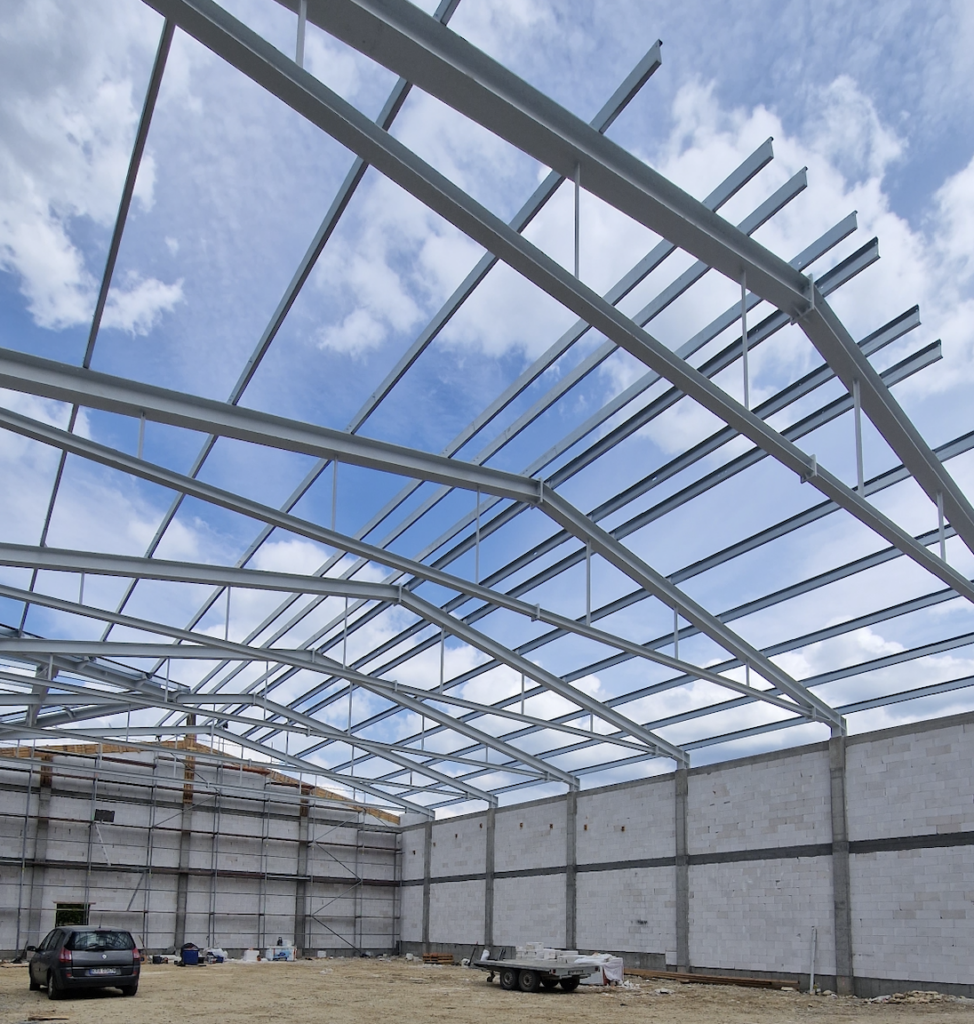
When seeking optimal solutions for their business, investors often use the terms „steel hall” and „sheet metal hall” interchangeably. In common understanding, the phrase „sheet metal hall” is usually associated with low cost and quick execution. However, from an engineering and professional construction process perspective, these terms refer to completely different aspects of the building. Understanding this difference is crucial to making an informed decision that will affect the durability, safety, and functionality of the building. In this article, we explain why a professional „sheet metal hall” is primarily a solid steel structure and when to opt for which finishing variants.
Construction and casing: what are you really building?
The key to dispelling doubts lies in distinguishing the hall's frame from its outer layer.
- Steel hall – this term refers directly to construction material, from which the carrier structure (load-bearing frame) of the object is made. It is a system of columns, beams and trusses that is responsible for transferring all loads (wind, snow or its own weight) to the foundations.
- Tin shed – this term actually refers to enclosure methods Hello. This means that a professional steel structure is covered with corrugated sheet metal.
At Matbud, we don't build flimsy sheds. Every project we undertake is based on a professional steel frame, which can be finished in two ways:
- Steel halls clad with trapezoidal sheeting – so-called „cold” halls, ideal for storing temperature-insensitive goods.
- Steel halls clad with sandwich panels – „warm” halls, providing thermal insulation, essential in production processes or food storage.
Why is a professional „tin shed” a better investment?
Many people, when typing the phrase „metal hall price” into a search engine, are looking for the cheapest market solutions. However, it's worth remembering that a professional steel hall clad with trapezoidal sheet metal from MatBud differs significantly from typical, lightweight garage sheds.
Safety and static analysis
Each of our constructions, regardless of the type of casing, has a full static and strength calculations. This means that the designer has precisely calculated how the building will behave during strong winds or when heavy layers of snow accumulate. For industrial buildings, standards (e.g. Eurocode 7) require that the settlement of the structure does not exceed permissible limits, which ensures stability and safety of use.
Durability for decades: hot-dip galvanizing
Unlike cheap sheet metal halls, which often corrode after just a few seasons, MatBud structures are, as standard, hot-dip galvanised. This is the most effective method of steel protection, ensuring the hall's frame remains intact for many years, eliminating maintenance costs.
Foundations: the base you can't afford to miss
Investors often wrongly assume that a „lightweight” sheet metal hall does not require solid foundations. However, it is the foundations that are responsible for the hall's stability under wind conditions or dynamic loads.
The choice of foundation depends on the soil parameters, which determine the mandatory geotechnical investigations. The most common methods are:
- Footings (point foundations): The most economical solution for a frame hall's posts.
- Strip foundations used along the line of walls, e.g. under retaining walls.
- Slab foundation ideal for land with poor load-bearing capacity, ensuring even distribution of the entire object's weight.
A properly constructed foundation, positioned below the frost depth of the ground (in Poland, from 0.8 m to 1.4 m), protects the building from frost heave deformations.
Speed like a prefabricated shed, quality of an industrial hall
One reason customers look for steel halls is time. At MatBud, we combine speed of completion with the highest engineering quality through a strategy multithreading. We offer not only bespoke modular steel halls. We currently have in stock 500 tonnes of ready-made steel structures available off-the-shelf. This drastically shortens the investment process.
Which case should I choose?
If cost-effectiveness is your priority and you don’t need thermal insulation, a steel hall clad with trapezoidal sheet metal will be the perfect choice. However, if you plan to heat the building, opt for sandwich panels.
Regardless of your chosen enclosure, the foundation of your business should be a solid, galvanised steel construction with full design documentation. Only such a solution guarantees that the building will be a safe and durable asset for your enterprise.
You don't know what dimensions for the hall will be most cost-effective? Use our configurator. In a few minutes, you'll be able to select the optimal width and type of housing and receive a preliminary quote, which will be an ideal starting point for discussions about foundations and installation.
FAQ
What is the difference between a steel hall and a sheet metal hall?
A steel hall primarily refers to the load-bearing structure of a building, made of steel columns, beams, and trusses. A sheet metal hall, on the other hand, describes the finishing method of the object – the professional steel framework is then clad with corrugated sheet metal.
When is it worth choosing a hall clad with trapezoidal sheet metal?
Corrugated sheet metal is primarily suitable for halls that do not require thermal insulation, for example, warehouses for temperature-resistant materials. It is an economical solution that allows for the creation of a durable and functional industrial facility.
Corrugated sheeting or sandwich panel – which to choose?
The choice depends on the intended use of the hall. Corrugated sheeting will be suitable for unheated buildings, whereas sandwich panels provide thermal insulation and will be better suited for production halls, heated warehouses, or buildings intended for the storage of products requiring stable temperatures.
Does a sheet metal hall require foundations?
Yes. Even a relatively light steel hall needs to be properly founded to remain stable under wind, snow, and other loads. The type of foundation is selected based, among other things, on the structural parameters and the results of geotechnical soil investigations.