



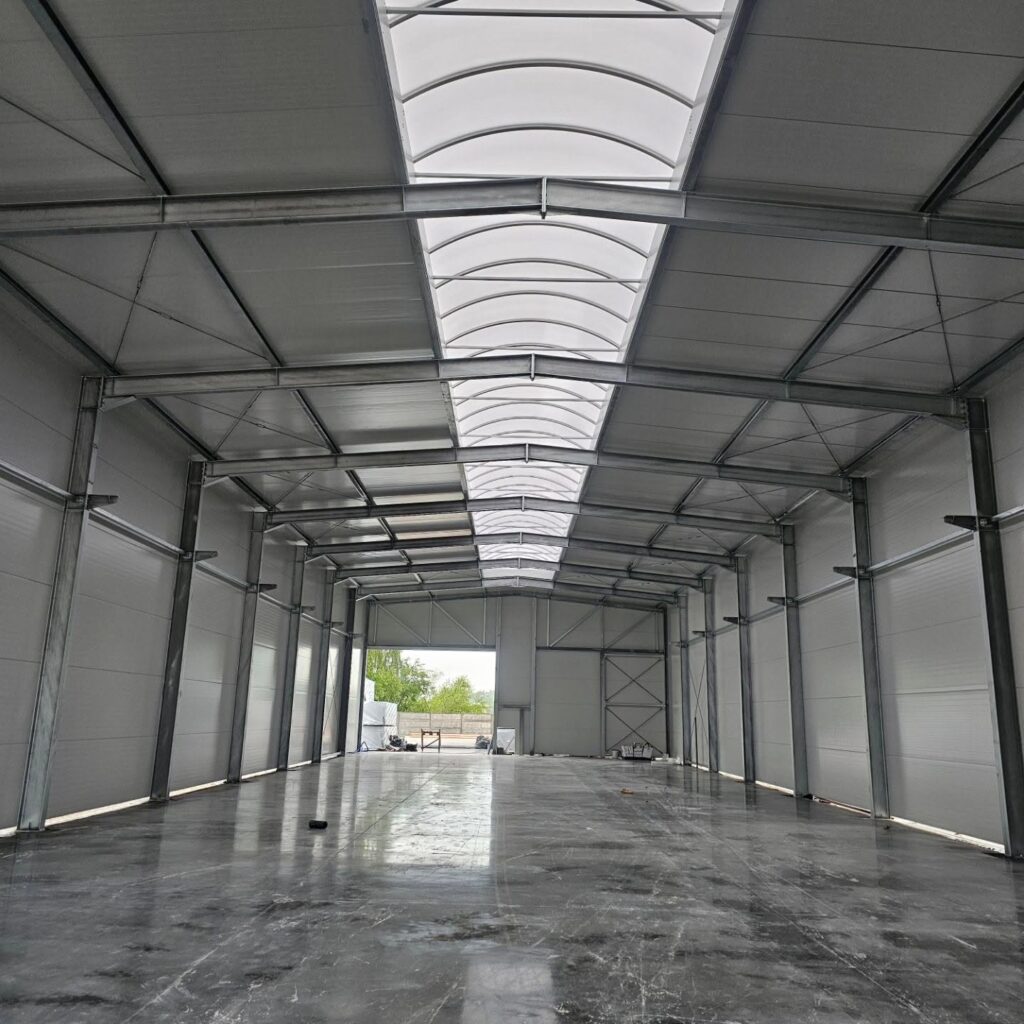
Sandwich panels or trapezoidal sheet metal – this question always comes up just before the quotation is drawn up. The cladding accounts for 20–30% of the hall’s cost, so the decision between „sandwich panels or trapezoidal sheet metal” can increase or decrease the budget by several tens of thousands of zlotys. At MatBud, our role is to advise you on what really pays off – not the most expensive solution, but the best one for your specific application. Below, we present four key criteria that will help you make an informed choice of cladding.
Cost – three-fold difference
Currently, a sandwich panel is approximately 3 times more expensive than trapezoidal sheet metal per m² of cladding. For a 500 m² hall, this difference can amount to tens of thousands of pounds. However, be aware – this is not an argument to always choose sheet metal. Sheet metal is bare cladding without insulation, whereas a sandwich panel is a finished, insulated wall. If you need to insulate the hall anyway, adding mineral wool with a vapour barrier and flashings will quickly eliminate the price difference, and often even turn it in favour of the panel.
Good news: MatBud constructions are designed with a load-bearing capacity reserve for sandwich panels. You can erect a hall with trapezoidal sheeting today, and in a few years – when the use changes – replace the cladding with panels without altering the structure. This is a real saving for investors who want to start cost-effectively but not close off the possibility of expansion or repurposing the facility.
2. Thermal Insulation – The Key Distinction
Corrugated metal sheeting This is bare sheeting, without insulation. It's suitable for unheated halls where the internal temperature can be close to the external one. On hot days and frosty nights, the difference relative to the surroundings is literally a few degrees.
In turn sandwich panel It's like a sandwich, consisting of two metal sheets and an insulating core (PIR, PUR or mineral wool). The U-value is from 0.18 W/(m²·K). The hall is immediately ready for heating or cooling.
The rule is simple: if a person is to work in the hall for 8 hours a day in winter, and a constant storage temperature is to be maintained – the panel is definitely the best choice. If it's a garage for agricultural machinery, a straw store, or an independent roof – corrugated sheeting will do the job for a fraction of the price.
3. Applications – what, where, and why it works in practice
Sandwich panels work excellently as:
- cold store or freezer cold store or freezer (we build facilities for, among others, the fruit and vegetable, food processing, and meat industries)
- Production hall heated,
- a facility for the food or pharmaceutical industry,
- The fruit and vegetable store under a controlled atmosphere,
- Workshop with office, showroom.
Corrugated sheeting is a natural choice for:
- straw, grain, fodder store,
- agricultural shelter, machine garage,
- building materials warehouse,
- production hall of „hot” processes (e.g. metal processing, where there is already a lot of technological heat inside),
- a shed for seasonal equipment.
4. Durability, aesthetics and maintenance
Both technologies are durable if fitted correctly. Sandwich panels look modern, have a smooth surface and a wide range of RAL colours – which is why they dominate in representative halls and showrooms. Trapezoidal sheeting is more „technical”, but this does not bother anyone in agricultural or storage halls, and owners value it for its resistance to mechanical impact and ease of repair.
From a maintenance perspective, both require the same: washing once a year, inspection of silicones and flashings around doors and windows, and repair of any mechanical damage. A sandwich panel requires the replacement of an entire section after being hit by a forklift, while sheet metal requires the replacement of a single sheet. This often proves decisive in warehouses with heavy internal traffic.
How and what do we advise?
At MatBud, we ask the investor three things: what will be happening in the hall, what internal temperature needs to be maintained, and what is the budget. If it's an unheated warehouse for straw or machinery – we recommend sheet metal and a structure prepared for potential future cladding replacement. If it's a cold store, for production, or for storing sensitive goods – we recommend sandwich panels straight away, as adding insulation to bare sheet metal later is more expensive and time-consuming.
The choice of casing also affects OHS conditions, energy consumption and the value of the property over the years. A hall insulated with sandwich panels is easier to sell or rent to a wider group of tenants on the secondary market – a non-heated sheet metal hall has a narrower range of buyers.
Insulated panels or corrugated sheeting – check both options
Use our configurator and compare the prices of steel sheet halls and sandwich panel halls with the same geometry. Or call: 780 770 705. We will tell you directly what is better for you – without suggesting a more expensive solution and without hidden costs.
FAQ
To wcześniej przygotowane elementy konstrukcyjne hali, które znajdują się już w magazynie producenta i mogą zostać szybko przeznaczone do realizacji konkretnej inwestycji. Pozwala to ograniczyć czas oczekiwania związany z produkcją konstrukcji od podstaw.
Yes. We offer modular steel structures available Off the shelf, designed for self-assembly. We supply a complete set of components along with documentation and instructions, allowing a local contractor to carry out the assembly.
Czy gotowa konstrukcja stalowa może być dopasowana do potrzeb inwestora?
Tak. Dostępne konstrukcje mogą stanowić bazę do stworzenia hali o określonym przeznaczeniu, np. magazynowym, produkcyjnym czy rolniczym. Kluczowe jest odpowiednie dopasowanie parametrów konstrukcji do wymiarów obiektu, lokalizacji oraz planowanego sposobu użytkowania.
Jakie są największe zalety gotowej konstrukcji stalowej?
Największą korzyścią jest skrócenie procesu inwestycyjnego. Inwestor nie musi czekać na pełny cykl produkcji elementów stalowych, a dodatkowo może wcześniej zabezpieczyć konstrukcję przed zmianami cen materiałów i szybciej przejść do kolejnych etapów realizacji.
Dla kogo gotowa hala stalowa będzie dobrym rozwiązaniem?
To rozwiązanie szczególnie korzystne dla firm i gospodarstw, którym zależy na szybkim zwiększeniu powierzchni magazynowej, produkcyjnej lub użytkowej. Sprawdzi się zwłaszcza wtedy, gdy czas rozpoczęcia inwestycji ma duże znaczenie biznesowe.