



Planning a construction investment in the summer period is an excellent strategy for any entrepreneur who wants to avoid winter downtime. Although the high temperatures outside do not make you think about frosts, it is precisely now that key decisions regarding thermal insulation are being made.
Thermal insulation – the heart of an energy-efficient building
One of the fundamental ways to prevent heat loss is proper cladding. At MatBud, we specialise in supplying halls where airtightness and thermal parameters are a priority. The most effective insulation material is PIR-core sandwich panels (you can find differences in the individual cladding methods in the article Sandwich panel or trapezoidal sheet metal).
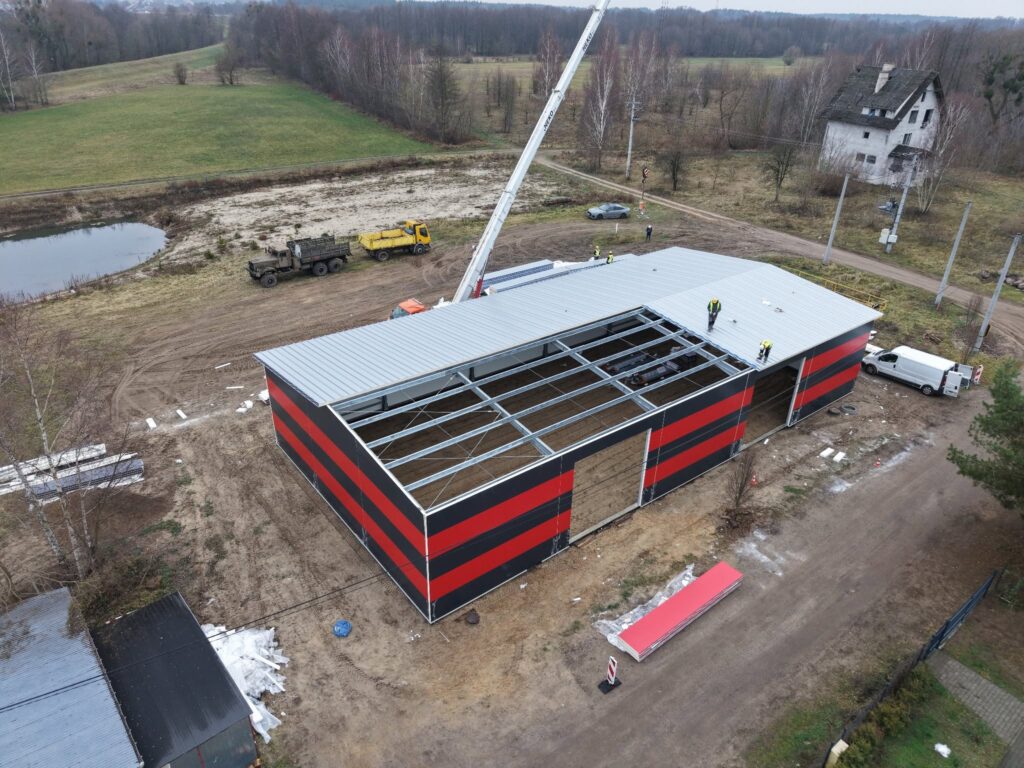
When considering how to insulate a steel building, it is worth taking a cue from the best projects. In Kraśnik, we built a service hall with an area of over 1,400 m², where 160 mm thick PIR panels were installed on the roof. A solid layer of insulation, combined with precise metal flashing and a gutter system, ensures that the facility retains heat even during severe winters. Such industrial halls are an investment that pays for itself after just a few heating seasons.
Effective heating of a steel hall versus assembly precision
The heat source alone is only half the battle. Efficient heating of a steel-framed building depends primarily on whether the building is airtight. Even the most modern heating system will not be up to the task if the hall has so-called thermal bridges. Thanks to the MatBud modular technology, based on highly repeatable elements, installation is carried out with millimetric precision. Prefabricated structural elements made of IPE beams fit together perfectly, which facilitates the tight installation of sandwich panels and fenestration.
Because at MatBud we provide a comprehensive service, when choosing our Warehouse sheds you receive a building in which every element, from the foundations to the ridge, is designed with the minimisation of energy losses in mind.
Durability and speed of construction – why it is worth building now
One of the biggest advantages of our systems is the speed of work. Ready-made modular Steel constructions they are available immediately at our yard, which allows for the delivery and assembly of the framework in as little as 7 days. Thanks to this, by starting construction in August or September, you can be sure that the building will be enclosed with insulation cladding before the first frosts.
Our clients repeatedly emphasise that the reliability and punctuality of our team allowed them to launch their business quickly and stress-free. Importantly, our halls are hot-dip galvanised, which ensures resistance to corrosion caused by water vapour condensation inside the insulated building – we provide a 10-year warranty on this. This is crucial because damp insulation loses its properties, and you lose money.
FAQ
What is the optimal sandwich panel thickness for a production hall?
As standard, we recommend PIR boards with a thickness of 100 to 160 mm, depending on the required temperature inside the building.
Does insulating a warehouse also protect it from overheating in summer?
Yes, the high insulation performance of PIR boards works both ways – in winter it keeps the heat inside, and in summer it prevents the interior from overheating.
How much can be saved through insulation optimisation?
A well-designed system can reduce heating costs by as much as 30–40% compared with buildings constructed using traditional methods.
Can I check the price of an insulated marquee online?
Certainly, you are welcome to use our tool, online calculator.
