



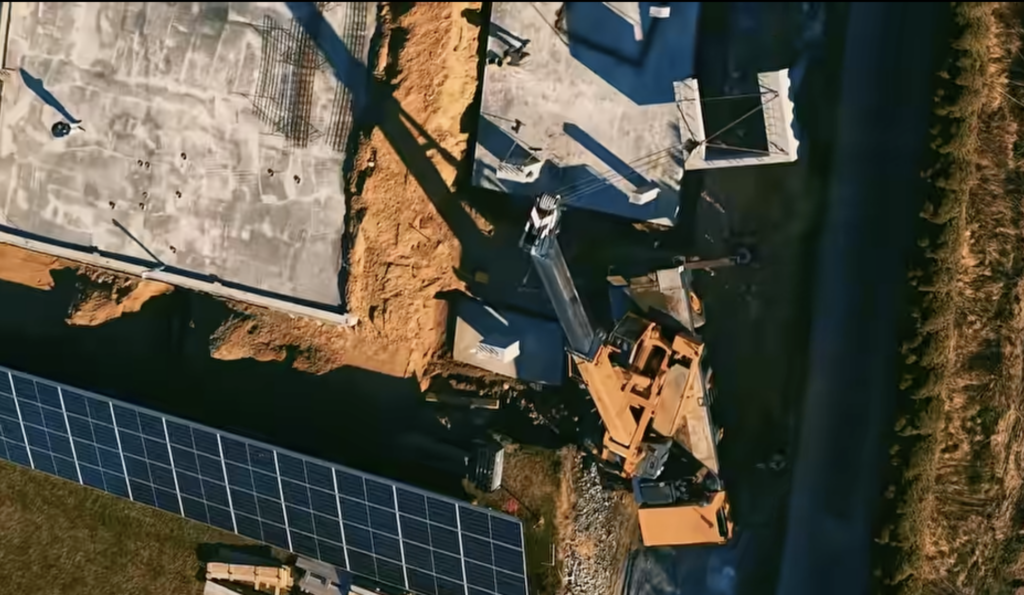
The construction of a steel building is a process in which most attention is focused on the impressive above-ground structure – trusses, framing, or modern sandwich panel cladding. However, what determines the durability, safety, and stability of the entire facility is hidden deep in the ground.
Law and standards: Eurocode 7 as an azimuth
Geotechnical design is currently based on rigorous European standards, specifically Eurocode 7 (PN-EN 1997). In this standard, traditional global safety factors have been abandoned in favour of the limit state method. In practice, this means that the designer must verify two key aspects:
– ultimate limit state (ULS), to prevent the foundation from failing,
– and the serviceability limit state (SLS), so that the settlement of the structure does not exceed permissible standards (usually up to 50 mm for industrial buildings).
An absolute requirement, which cannot be overlooked, is to conduct professional soil investigations. Geotechnical boreholes allow for the determination of the ground's load-bearing capacity, layer structure, and groundwater level. Without reliable geotechnical documentation, it is impossible to prepare a safe foundation design, which may expose the investor to enormous costs associated with the necessity of subsequent ground reinforcement.
Types of foundations – pad, strip or slab?
The choice of foundation method depends on two factors: forces transferred by the structure and soil parameters.
- Pad foundations (isolated foundations): This is the most popular and economical solution for framed structures. Each steel column is mounted on a separate foundation – a rectangular reinforced concrete block that distributes normal forces, shear forces and bending moments to the ground.
- Foundation slab: A recommended solution for soils with low load-bearing capacity, in mining damage areas or with a high groundwater table. The slab distributes the weight of the structure over its entire surface, which minimises the risk of uneven settlement. Importantly, by constructing the slab, the investor simultaneously gains a ready-made foundation and sub-base for an industrial floor, which speeds up construction work.
- Indirect foundation (piles and micropiles): Used in extreme situations, when load-bearing soil layers are several or a dozen or so metres underground. This requires specialist equipment and generates the highest costs.
Key technical parameters: frost and water
One of the most important technical requirements is the placing of foundations below the depth of ground frost. In Poland, depending on the region, this zone ranges from 0.8 m to 1.4 m (conventionally, 1.0 m is often assumed). This makes it possible to avoid so-called frost heave, which could deform the structure.
Protection against dampness is equally important. Foundations must be resistant to groundwater by using concrete of a high watertightness class (from W8 to W12) and surface insulation (bitumen compounds, roofing felt, PVC foils). Proper waterproofing protects not only the concrete but, most importantly, the steel bases of the columns against corrosion.
How to avoid costly mistakes?
A solid foundation is an investment in peace of mind. The most important principles for an investor are:
- Never give up on ground investigations – they determine safety.
- Ensure precision in anchoring – the hall's columns must fit the foundation with millimetric accuracy.
- Choose tried and tested solutions – MatBud structures are hot-dip galvanised as standard, which, combined with a good foundation, guarantees durability for decades.
Innovative „multi-track” investments with MatBud
In the traditional hall construction model, the investor waits for the design, then for the planning permission, and finally for the production of the structure. At MatBud we offer an alternative approach. Thanks to the fact that, in addition to custom-made modular steel halls, we also have ready-made steel structures (500 tonnes available immediately in our warehouse), the process can run on multiple tracks simultaneously.
By purchasing a pre-made structure, the investor receives full static and strength calculations included in the price. This is crucial information for the foundations designer – they do not have to wait for the work on the hall framework to finish, because they receive ready-made data on loads. Thanks to this, the foundations can be designed and built faster, and you, as the investor, avoid the risk of steel price increases by securing the goods right at the start.
If you are planning construction, check out our configurator. It will allow you to estimate the scope of the investment in a few minutes, choose the dimensions (e.g., 15 m, 18 m, or 22 m in width) and obtain an initial quotation that will be a solid starting point for discussions on foundations and assembly.
FAQ
These are pre-fabricated structural elements for a hall, already held in the manufacturer's warehouse and ready to be quickly allocated to a specific investment. This reduces the waiting time associated with manufacturing the structure from scratch.
Yes. We offer modular steel structures available for immediate delivery, designed for self-assembly. We supply a complete set of components, together with documentation and instructions, so that assembly can be carried out by a local contractor.
Can a ready-made steel structure be adapted to the investor's needs?
Yes. The available constructions can form the basis for creating a hall for a specific purpose, e.g. warehousing, production or agricultural. It is crucial to appropriately match the construction parameters to the object's dimensions, location and planned use.
What are the main advantages of pre-engineered steel construction?
The biggest benefit is shortening the investment process. The investor does not have to wait for the full production cycle of steel elements, and additionally, they can secure the structure against material price changes earlier and move on to the next stages of implementation more quickly.
A ready-made steel hall will be a good solution for whom?
This solution is particularly beneficial for companies and farms that need to quickly increase their storage, production, or usable space. It is especially suitable when the time to start an investment is of great business importance.
